
Serres Sylva bC Suction Bag: How Bio-Based Plastics Can Reduce Emissions in Healthcare

Healthcare relies on plastic products to support patient safety, infection prevention and efficient clinical care. At the same time, hospitals and healthcare organizations are looking for ways to reduce emissions from healthcare plastics and other purchased medical products.
A growing area of interest is using renewable and bio-based raw materials to reduce reliance on fossil carbon while maintaining the performance required of healthcare products. One example is the Serres Sylva® bC suction bag.
Introducing Serres Sylva® bC 2 L suction Bag
The Serres Sylva® bC suction bag combines renewable carbon, ISCC PLUS-certified bio-based plastic using a mass balancing approach, and circular-ready design principles in a healthcare suction bag developed for modern hospital environments. It shows how changing the carbon source in plastic production can reduce reliance on fossil-based raw materials while maintaining the material properties required in healthcare.
- Contains 68% ISCC PLUS-certified bio-based plastic manufactured using plant-based used (waste based) cooking oil (UCO) as a feedstock.
- Reported a 28% reduction in fossil greenhouse gas emissions in a carbon handprint case study compared with a conventional fossil-based alternative.
- Required no changes to hospital workflows or clinical practices in the reference hospital scenario.
- Has the same quality and same performance as the fossil-based suction bag.
How can hospitals reduce emissions associated with essential plastic products without compromising clinical performance?
Plastic products play an important role in modern healthcare. They support safe and efficient patient care, infection prevention, and clinical workflows.
The challenge for healthcare organizations is therefore not simply to eliminate plastic. Hospitals need ways to reduce the environmental impact of essential plastic products while maintaining their safety, functionality and usability.
The World Health Organization recognizes the important role of plastics in safe and affordable healthcare while also highlighting the need to reduce the climate and environmental impacts associated with plastic products throughout their lifecycle.
One part of the answer may be to consider not only how much plastic is used, but also where the carbon used to produce that plastic comes from.
Why Does Fossil Carbon Matter in Healthcare Plastics?
Most conventional healthcare plastics are manufactured using fossil-based raw materials such as oil and natural gas.
Fossil carbon has been stored underground for millions of years. When fossil resources are extracted and used to manufacture products, this carbon enters the active carbon cycle. At the end of a product’s life, some of this fossil carbon can ultimately be released into the atmosphere as carbon dioxide (CO₂).
For healthcare organizations seeking to reduce emissions from purchased products, raw material choice can therefore be an important consideration.
A life cycle assessment of a single-use medical device found that approximately 45% of its greenhouse gas emissions were associated with raw material production. This illustrates how the materials used to manufacture healthcare products can influence their environmental performance.
For the Serres Sylva® bC suction bag, sustainability is therefore not only about the amount of plastic in the product. It is also about the source of the carbon used to produce that plastic.
What is Renewable Carbon?
Renewable carbon provides an alternative to fossil carbon.
Renewable carbon can come from biomass or biological waste and residue streams that are already part of the natural carbon cycle. Plants absorb carbon dioxide (CO₂) through photosynthesis, and this biogenic carbon can subsequently be used as a raw material for products, including plastics.
One example is used cooking oil (UCO). Used cooking oil is a waste and residue stream that certified production systems can convert into raw materials for plastic production. In the Serres Sylva® bC suction bag, plant-based used cooking oil is used as the feedstock for the bio-based plastic content.
Because UCO is a waste and residue stream, its use as a feedstock avoids direct competition with food production.
The approach changes the source of the carbon entering the material system and can help reduce reliance on new fossil carbon inputs.
Same Plastic. Different Source
One of the key points about the Serres Sylva® bC suction bag is that the bio-circular plastic is not a different or alternative polymer.
The polymer used in the Serres Sylva® bC suction bag is chemically identical to the fossil-based polymer used in the Serres Sylva® Suction bag.
The polymer is the same. The material source is different.
The difference is in the origin of the carbon used to manufacture the polymer. Instead of relying entirely on fossil feedstocks, part of the carbon originates from renewable sources and is allocated through the ISCC PLUS-certified mass balance approach.
Because the polymer is chemically identical, changing the carbon source does not require changing the polymer itself. This supports the same product quality, material performance, safety and compatibility expected from the Serres suction system.
In other words, the environmental benefit comes from changing the raw material source, not from changing the polymer or redesigning the clinical workflow.
What is the Environmental Impact of the Serres Sylva® bC suction bag?
A carbon handprint case study compared the Serres Sylva® bC 2 L suction bag with a conventional fossil-based alternative in a reference hospital scenario.
The assessment considered the product lifecycle from raw material production and manufacturing through transportation, use and end-of-life treatment.
The study reported:
- 28% reduction in fossil greenhouse gas emissions
- 3.99 tonnes CO₂e carbon handprint from avoided fossil emissions per 100,000 suction bags annually
- No changes required to hospital workflows or clinical practices
The reported carbon handprint represents avoided fossil greenhouse gas emissions compared with the conventional fossil-based alternative. It does not include additional benefits associated with carbon captured by plants, also referred to as biogenic carbon.
The case study therefore demonstrates how changing the raw material source can contribute to lower fossil greenhouse gas emissions while maintaining the functionality required in the reference hospital scenario.
Can Bio-Based Plastics Reduce Healthcare Emissions?
A meta-analysis of bio-based products found that emerging bio-based products delivered, on average, 45% lower greenhouse gas emissions compared with relevant fossil-based alternatives.
This does not mean that every bio-based healthcare product achieves a 45% reduction. The actual climate impact depends on the specific product, raw materials, manufacturing processes, transport, use and end-of-life treatment.
Research also indicates that circular economy strategies can contribute to lower emissions. A European Environment Agency review covering 131 studies found that circular economy strategies reduced greenhouse gas emissions by an average of 33%.
Together, these findings indicate that renewable carbon and circularity can both contribute to reducing the climate impact of products.
Healthcare spesific evidence
A healthcare suction bag assessment cited in the original case study found that a suction bag containing 68% bio-based material reduced emissions by approximately 23% under an incineration end-of-life scenario. When mechanical recycling was included, the reported reduction increased to approximately 37%.
These results relate to that specific assessment and should not be interpreted as the emission reduction of every bio-based suction bag or as the result of the Serres Sylva® bC suction bag case study. The 28% reduction reported above refers specifically to the Serres Sylva® bC case study.
What IS ISCC PLUS?
ISCC PLUS is a certification system supporting sustainable and traceable supply chains.
For the Serres Sylva® bC suction bag, ISCC PLUS supports the certified allocation of renewable content through the mass balance approach.
Mass balance allows renewable and fossil raw materials to be processed within the same production system while enabling the renewable share to be traced and allocated according to the applicable certification system.
One way to understand the concept is to compare it with an electricity grid: renewable and conventional electricity can flow through the same network while the renewable share is tracked and accounted for. The mass balance concept applies a similar principle to plastic feedstocks.
“Think of mass balance like the electricity grid: renewable and conventional energy flow together, but the share of renewable energy is measured and credited. The same principle applies to plastics.”
A pathway to lower-impact healthcare plastics
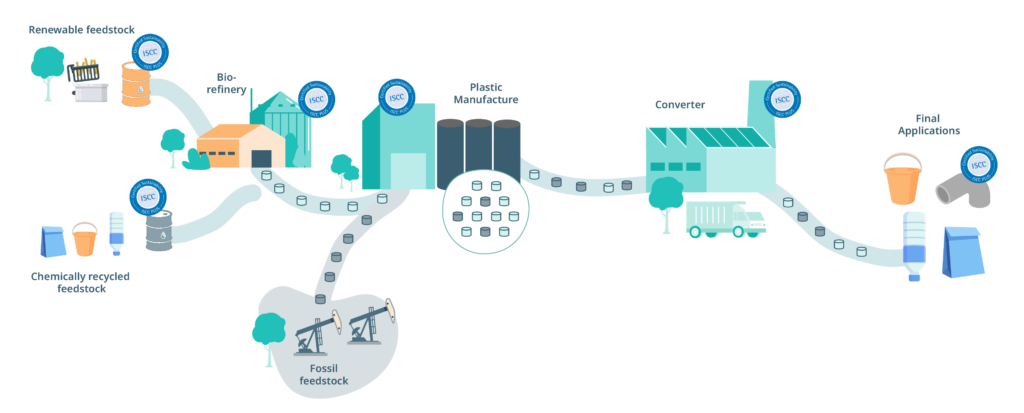
Figure 1. Simplified illustration of the mass balance approach. Renewable and fossil feedstocks are processed within the same plastic manufacturing system, while certified accounting ensures that the allocated share of renewable content can be traced through the value chain. Products maintain the same quality and performance as fossil-based alternatives.
Renewable Carbon and Circularity
Replacing fossil-based raw materials with renewable alternatives can reduce emissions today. However, raw material substitution is only one part of the transition towards more sustainable healthcare plastics.
Keeping materials in use for longer through recycling and other circular approaches may provide additional environmental benefits.
For products such as the Serres Sylva® bC suction bag, the bio-based material contains plant-derived carbon. If that material can remain in use through recycling and other circular systems, it may create additional environmental value.
The scale of any future benefit depends on real-world conditions, including:
- Product design
- Collection systems
- Recycling infrastructure
- Material retention
- Repeated material use
For this reason, renewable carbon and circularity should be viewed as complementary approaches rather than as a single solution.
Supporting Net-Zero Healthcare
Healthcare will continue to rely on plastic products to deliver safe and effective care. The sustainability challenge is therefore to reduce the emissions associated with essential healthcare plastics while maintaining their required functionality and supporting clinical workflows.
The Serres Sylva® bC suction bag demonstrates one approach: replacing part of the fossil-based raw material with ISCC PLUS-certified bio-circular plastic content.
In the case study, this resulted in a 28% reduction in fossil greenhouse gas emissions compared with a conventional fossil-based alternative, without changes to hospital workflows or clinical practices.
Future opportunities may come from combining renewable carbon with circular economy approaches, including recycling and improved material circulation.
The future of healthcare plastics is therefore not necessarily about choosing between performance and sustainability. It is about developing material strategies that reduce dependence on fossil carbon while maintaining the properties and usability required in healthcare.
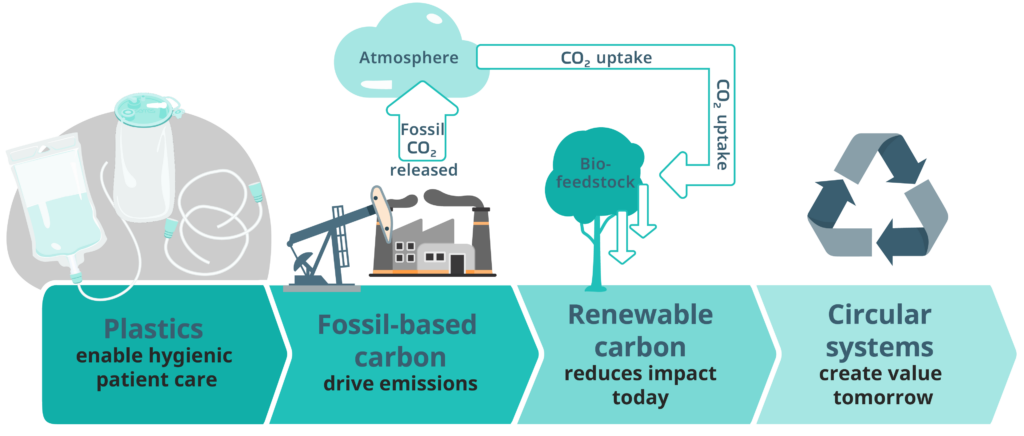
Figure 2. A pathway to lower-impact healthcare plastics.
References
- WHO Health dialogue: Plastics in health care
- Cradle-to-grave greenhouse gas emissions from a 0.5-mL single-use medical device
- Meta-analysis of bio-based products: https://doi.org/10.1038/s41467-023-43797-9
- European Environment Agency: Assessing the climate mitigation potential of circular economy
- Renewable carbon research: https://doi.org/10.52548/HRPM7087
- Silvennoinen et al., healthcare suction bag case study
- GHG Protocol, Land Sector and Removals Standard
- Carbon Handprint Guide, VTT and LUT Univers